

AI Product Demo Videos for E-Commerce and Retail Brands in Saudi Arabia


If your product page or marketplace listing relies on static images, you're leaving conversions on the table. Product demo videos — short, focused clips that show what a product does and why it matters — are consistently the highest-performing asset on Saudi e-commerce platforms and retail landing pages. AI video production makes it possible to produce them at the volume and speed modern retail demands, without the cost or coordination of a traditional studio shoot for every SKU.
What a product demo video actually needs to do
A product demo video has one job: answer the buyer's question before they leave the page. It is not a brand film. It is not a 30-second brand spot. It is a direct-response asset with a single conversion objective.
The structure that performs: an immediate product reveal, a clear demonstration of function or benefit, and a direct close — where to buy, how to get it. Length varies by format: 15–30 seconds for most listing environments, up to 60 seconds for a website hero or detailed feature explainer. Every second that doesn't serve the conversion objective is a second that gives the viewer a reason to leave.
Getting the brief right before production starts is what separates a video that converts from one that looks good in isolation. Sadara Studio builds demos from a structured brief: product references, the one claim the video must land, the platform it lives on, and the action it should drive.
How AI changes the economics of product demo production
Traditional product video shoots require a physical set, lighting rigs, props, talent, and a post-production team — and they produce one version of one SKU. A product line of twenty items means twenty shoots, twenty sets of revisions, and a timeline that keeps new launches waiting in a queue.
AI production replaces most of that setup. Products are visualised from high-resolution photography, packaging files, 3D references, or existing creative assets. The brand system — colours, typeface, motion style, voiceover treatment — is defined once and applied consistently across every demo, whether it is item one or item one hundred. Brands that need to refresh seasonal demos or launch a new variant don't return to a physical studio: they send a brief and the updated content is production-ready within days.
The efficiency gain is real, but it is not the same as cutting corners. The visual discipline required to make a product look good on screen — correct lighting, legible labels, motion that draws the eye to the right feature — is still design work. AI accelerates the execution; the craft decisions still need to be made correctly.
Format requirements by channel
Saudi e-commerce and retail brands typically need the same core demo adapted for three distinct environments, each with its own technical and creative requirements:
- Website hero: 16:9 or fullscreen, 30–60 seconds, higher production depth, voiceover or captioned for accessibility.
- Marketplace listing (Amazon.sa, Noon, Salla): platform-specific aspect ratio and file specifications, subtitles required for autoplay environments, concise at 15–30 seconds.
- Social ad (Instagram Reels, TikTok, Snapchat): 9:16, 6–15 seconds, hook in the first two seconds, muted-autoplay safe.
Sadara Studio produces all three format variants from the same brief. The brand's approved system is applied once and carries across every cut — brands don't receive three separately negotiated edits; they receive a single coherent campaign adapted correctly for each surface.
Craft that separates a converting demo from a forgettable one
Speed and volume are irrelevant if the video doesn't make the product look right. Demo production requires rigorous art direction: the product must be lit correctly, motion must draw attention to the right features, and copy must land clearly at every font size and in every viewing context.
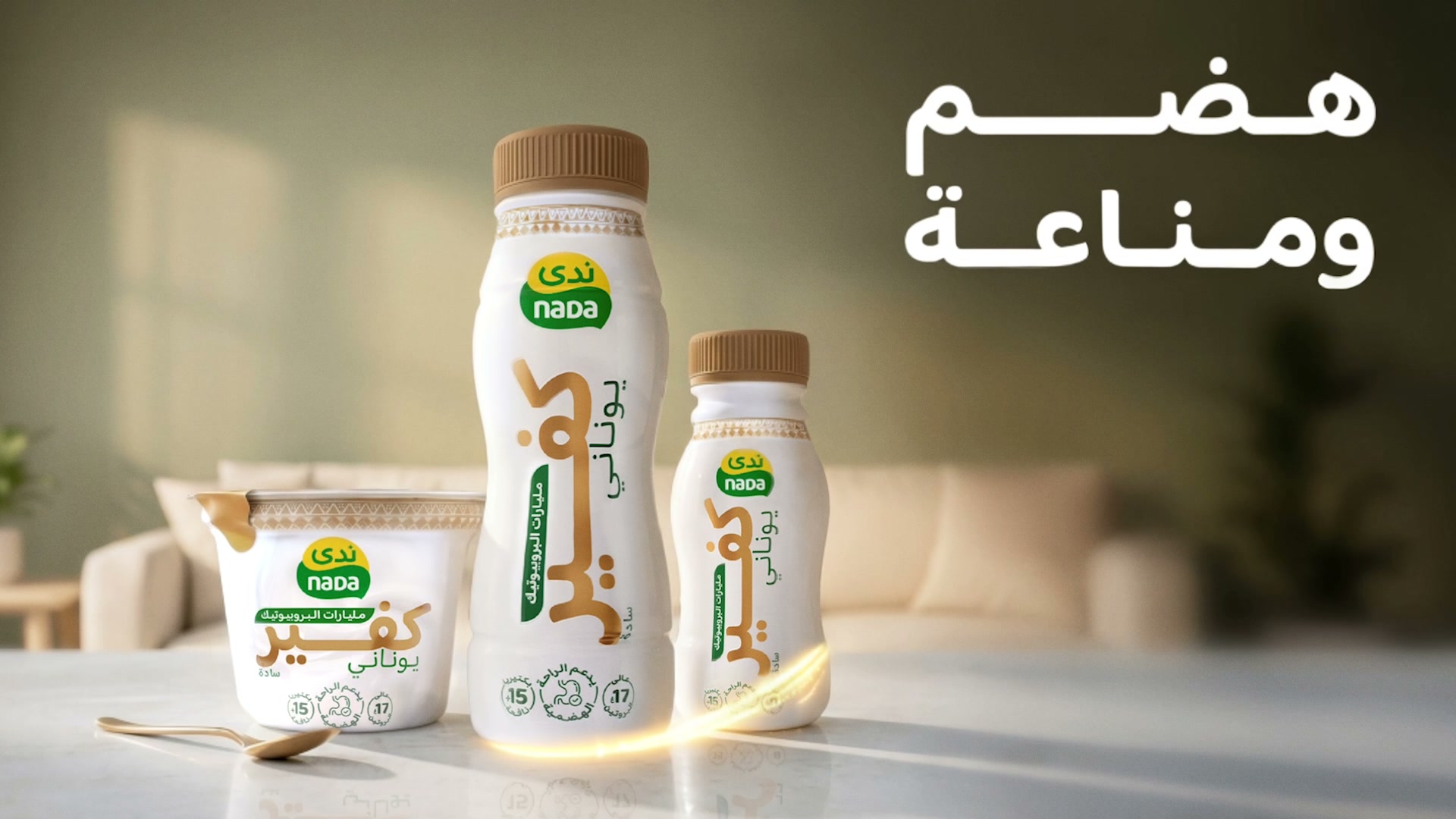
Sadara Studio's production process starts with visual references and environment guidelines before a single frame is generated. On the Nada Greek Kefir campaign, the visual brief specified exact label legibility standards, lighting temperature, and how condensation should render on cold product — details that determine whether a viewer reaches for it or scrolls past. That level of direction is not optional on a product that competes on shelf and on screen simultaneously.
For retail and e-commerce clients, that same discipline is applied to every SKU in the catalogue. A demo that shows Al Tazaj's product line has to make grilled chicken look as considered as a luxury beauty product's packaging shot. The tool is AI; the standard is still craft.
Scaling demo production without losing consistency
The most common concern brands raise about catalogue-scale demo production is consistency: if fifty demo videos are produced across a range, does the fiftieth item look as deliberate as the first?
The answer is a locked visual system. Before production scales, Sadara Studio defines a demo-specific style guide: motion timing, colour grading rules, type lockup specifications, and voiceover treatment. Every subsequent demo is produced against that system. Brand managers review against a consistent benchmark, not a blank canvas, which means revisions target specific deviations rather than open-ended creative judgment calls. The system is the quality gate, not the individual clip.
For brands refreshing seasonal content — a product range getting a Ramadan look or a new flavour dropping with a campaign — the system means the new assets are demonstrably on-brand from the first draft, not after three rounds of corrections.
Frequently asked questions
What types of products work best for AI product demo videos?
Any product where function, texture, or benefit can be shown visually responds well to demo video. FMCG, food and beverage, personal care, electronics accessories, fashion, and home goods all perform strongly. Products that rely on sensory experience — fragrance, fabric hand-feel — benefit most from demonstrating the context of use or the outcome rather than the product itself. The brief determines the approach; the format follows from what the buyer most needs to see.
Can a demo be produced if I only have photography, not 3D files?
Yes. Sadara Studio regularly builds product demos starting from high-resolution photography, packaging files, and brand guidelines. Reference photography establishes the lighting and surface treatment; AI handles the motion and scene construction. For brands that want a consistently updatable system across a catalogue, providing 3D files or additional photography angles speeds the process — but it is not a prerequisite to getting started.
How many format variants can be produced from a single brief?
A standard brief typically produces three to five platform-specific cuts: a website hero, one or two marketplace formats, and one or two social aspect ratios. Brands with a broader channel mix — including out-of-home screens or in-store digital signage — can extend to more variants. The core creative and art direction work is done once; additional formats are derived from it rather than rebuilt from scratch.
How quickly can a product demo be delivered?
A single demo from a complete brief — product reference, approved copy, and a confirmed brand system — can be ready for review within a few days. Catalogue batches of ten to twenty items run in parallel and deliver in weeks rather than months, without the scheduling overhead of a traditional shoot. Brands with a hard campaign launch date should bring in the brief as early as possible; the production window is short by traditional standards, but it still needs to be planned.
Get a product demo that earns its place on your listing
Sadara Studio designs and delivers AI product demo videos for Saudi e-commerce and retail brands in Riyadh and Jeddah. If you have a product to launch, a catalogue to cover, or a listing that isn't converting, start a conversation with the team.
Related Articles



Sadara
Studio

