

Multi-Language AI Video: Arabic, English and Beyond for Saudi Brands

The brief arrives asking for a 60-second brand film. Then the client adds: "We need it in Arabic, English, and French for the regional push." A traditional production house calculates three separate shoots, three voiceover studio sessions, three timelines. Sadara Studio builds once, then adapts — because that is what an AI-native production pipeline makes structurally possible.
The multi-language challenge Saudi brands actually face
Saudi Arabia's brand landscape is genuinely bilingual, and often trilingual. Most regional campaigns run in Gulf Arabic first, English second, and a growing number of brands — those targeting expatriate communities, regional neighbors, or international markets — add Egyptian Arabic, Levantine, or other languages for specific audiences.
Traditional video production treats each language version as a separate production: a new voiceover session, a new motion-graphics pass, a new quality-control round. The result is usually a compressed secondary timeline where the Arabic version ends up feeling like an afterthought — rushed to match a visual edit built for English. AI-native production reverses this. The visual layer is language-independent by design, so language versions multiply without multiplying the production effort.
Arabic-first, not Arabic-adapted
Sadara Studio structures multi-language campaigns Arabic-first. The script, the visual edit's timing, and the emotional arc of the piece are built around the Arabic voiceover before any other language version is introduced.
Arabic voiceover has different rhythmic properties than English. Sentences run longer at similar information density; the cadence of Gulf colloquial Arabic differs meaningfully from Modern Standard Arabic; the natural pause after an Arabic phrase rarely lands in the same place as its English equivalent. A commercial cut to English timing and then dubbed into Arabic will always feel slightly off — the pauses land in the wrong place, the energy of the delivery doesn't match the visual edit.
Working Arabic-first means the edit breathes correctly in the primary language. English, French, or any other version then adapts a piece that already works — rather than fighting a structure built for a different language.
One brief, multiple language outputs
The production workflow for a multi-language AI campaign at Sadara Studio:
- Parallel scripting from a single brief — all target languages are confirmed upfront. Scripts for each language are developed in parallel, not translated sequentially, so the core message is consistent rather than a translation of a translation.
- Single visual production pass — character design, environments, motion graphics, and the full animation pass happen once. The visual layer is locked before any language version is cut.
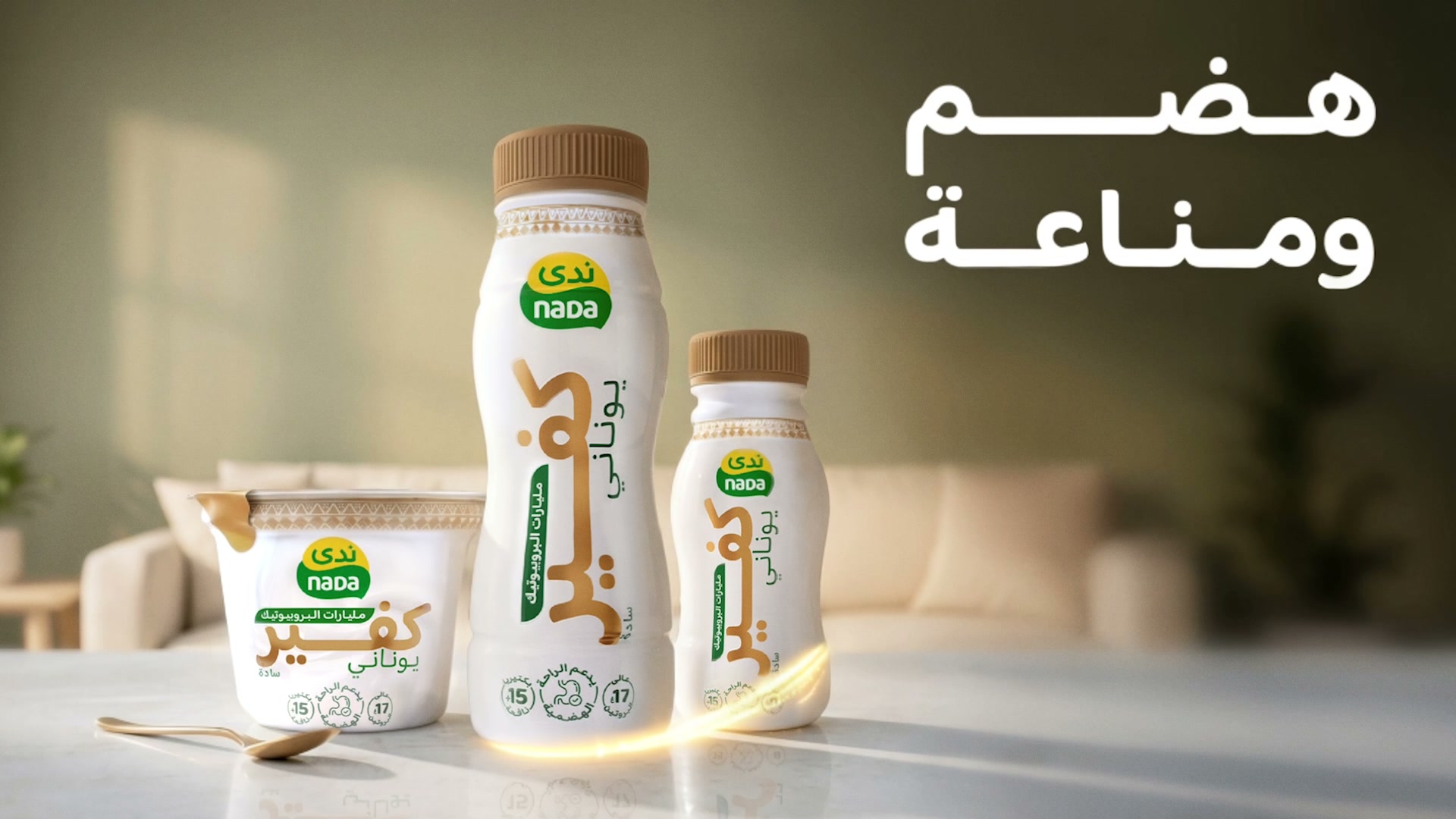
- Per-language voiceover and edit — each language version gets its own voiceover session. The edit is then cut to fit that voiceover, not the reverse. The Nada Greek Kefir campaign used exactly this principle: the character design, environments, and motion were completed as a self-contained visual world before any distribution-specific elements were introduced.
- Templated on-screen text and supers — product names, calls to action, and legal supers are set up so Arabic right-to-left and Latin left-to-right versions both pass visual quality control without repositioning every element by hand.
- Standalone final deliverables — each language version ships as its own file with its own dedicated quality pass, not extracted from a parent timeline.
Dialect, accent, and subtitle handling
"Arabic voiceover" is not one thing. A Gulf brand targeting Saudi consumers needs different choices than a campaign aimed at an Egyptian broadcast audience or a Levantine market. Sadara Studio advises on dialect selection before production — because the right Arabic variant affects which AI voice profile is cast, how the script is phrased, and what register the audience expects.
Subtitles and captions are treated as separate deliverables. Social-first formats for TikTok and Instagram Reels almost always require Arabic captions for silent viewing; broadcast-spec versions typically do not. Both get their own file, and neither is generated automatically from a voiceover transcript without a human accuracy pass.
Bilingual subtitles — Arabic and English on the same frame — require deliberate layout decisions. Font size, line length, and vertical positioning are controlled as a design problem, not a translation one, so both languages remain legible without the frame feeling crowded.
Frequently asked questions
Which languages does Sadara Studio produce AI video in?
Sadara Studio currently produces in Arabic (Gulf, Modern Standard, Egyptian, and Levantine dialects), English, and French, with other languages handled on a project-by-project basis. The limiting factor is always voiceover accuracy and script quality, not the production pipeline itself.
Can the visual layer stay the same across all language versions?
Yes. Character animation, environments, and motion graphics are language-independent and completed in a single production pass. Each language version shares the same visual world; only the voiceover, on-screen text, and the timing of the edit change per language.
How do you handle Arabic dialects in AI-generated voiceover?
Sadara Studio selects the AI voice profile — Gulf, Levantine, or Egyptian — at the scripting stage, not in post-production. Dialect and accent are briefed upfront. Formal Modern Standard Arabic is available for broadcast or government contexts where a neutral register is required.
How long does a multi-language AI video campaign take compared to a single-language one?
A two-language campaign (Arabic and English) takes only marginally longer than a single-language piece, because the visual production is fully shared. Each additional language adds a voiceover session and a per-language edit pass — not a new production cycle. The cumulative time saving versus running separate productions per language is substantial.
Produce your campaign once, deliver it everywhere
Saudi brands distributing across Arabic dialects, English, and additional languages can produce all versions from a single creative brief and a single production cycle. Sadara Studio handles the full pipeline — from Arabic-first scripting through final per-language delivery. Talk to the team to scope your next multi-language campaign.
Related Articles

%20Enhanced_Thumbnail.webp)


Sadara
Studio

